
From Opportunity to Introduction: How Partner-Led Growth Works
Partner-led growth is usually described as one thing: get more partners, get more referrals. In practice it is a sequence of five distinct stages, and most programs only ever build the first one. A signed partner with a link is the beginning of the motion, not the whole of it.
This guide is a map of the full sequence, from spotting where an opportunity exists to the warm introduction that actually moves a merchant. Each stage links to a full guide, so use this as the overview and follow the links for depth on any one step.
TL;DR: The Partner-Led Growth Motion
The Five Stages
Each stage answers a different question, and each has its own dedicated guide. This page is the map between them.
Stage 1: Find the Opportunity
Opportunity comes from two directions. It can already be sitting inside partners you have signed but never fully activated, or it can be hiding in merchants you already have, served by agencies you have not met yet.
The first direction is covered in revenue hidden in your partner network, which looks for dormant, underperforming, and under-enabled partners already in your program. The second is covered in turning merchant overlap into partner opportunities, which finds agencies through reviews, support tickets, and theme credits rather than cold recruitment.
A third version of this stage is reactive rather than proactive. Identifying which partner can help close an opportunity applies the same discovery logic to a single stalled deal already in motion, rather than a full network review.
Stage 2: Rank It
Not every opportunity deserves the same attention. Ranking replaces gut feel with an expected-revenue calculation: the chance an opportunity converts, times the value of the merchant, times how long they are likely to stay. The full formula and a worked example are in prioritizing partner opportunities by revenue potential, where a large, high-volume agency and a small, high-retention one are ranked in opposite orders depending on which measure is used.
Stage 3: Match It to a Partner
Once an opportunity is ranked, it needs a specific partner. That decision runs on fit, covered in what makes an agency a good match, and on routing logic, covered in matching the right agency to the right merchant. Fit and availability both matter here. The best partner on paper is the wrong choice if they have no capacity to take on the work.
Stage 4: Prompt a Warm Introduction
This stage is where partner-led growth earns its name. A referral link shared passively is not the same as a warm introduction actively made. How warm introductions improve Shopify app partner conversion covers the conversion difference between the two and how to prompt the second, not just the first.
The models an agency can use to reach a merchant, beyond sharing a link, are covered in agency partnerships beyond referral links.
Stage 5: Track and Credit the Outcome
The final stage closes the loop. Every introduction needs to be attributed to the partner who made it, whether it came through a tracked link or a direct conversation with no click at all. That mechanics is covered in tracking affiliate referrals for Shopify apps. What you owe a partner for the outcome, beyond simple commission, is covered in creating revenue opportunities for agency partners.
Where Most Programs Break Down
Programs rarely fail because no stage exists at all. They fail because one stage is missing, and the whole sequence stalls at that point.
A program can survive a missing stage. It cannot survive missing all of them, and most programs that feel stuck have quietly skipped more than one. Crossbeam's guidance on surfacing overlap makes a similar point at enterprise scale: teams that start with a full view and filter down move faster than teams trying to build a process from scratch, one stage at a time, with no visibility into the whole.
Where Orbit Fits in the Sequence
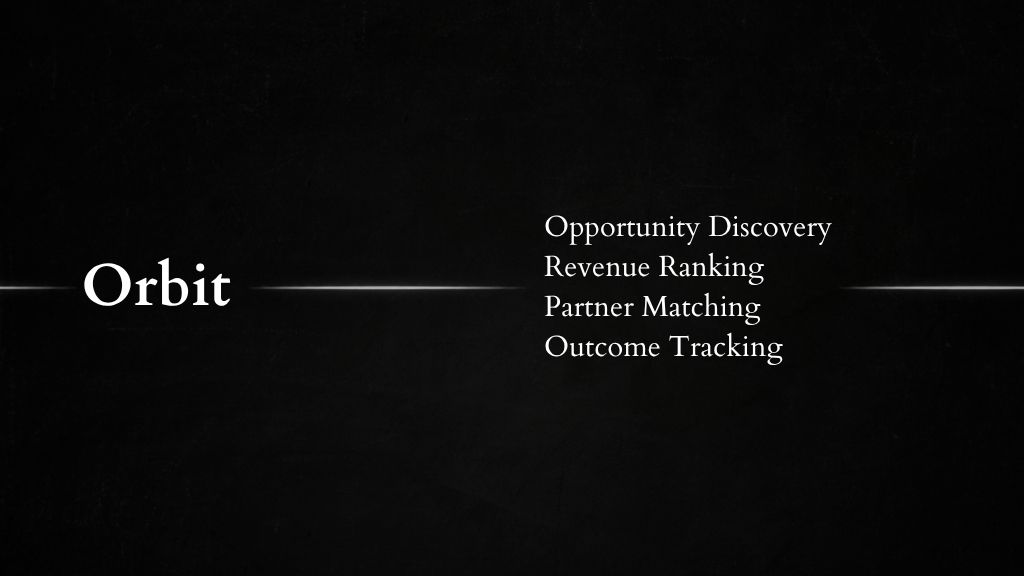
Orbit, Marmeto's standalone partner management product, sits mainly at stage five, tracking referral attribution, commissions, and payouts per partner. The earlier stages, finding opportunity, ranking it, and matching it, draw on merchant and revenue data that sits inside Elevate. The two together cover the full sequence, one product per half of the motion.
Partner-led and ecosystem-led growth content, including Crossbeam's own description of the category, is thorough for enterprise SaaS companies running dedicated partnership teams and account-mapping platforms. None of it maps the sequence for a Shopify app, where the partner is usually an agency and the tooling is lighter. That gap is where this page sits.
Frequently Asked Questions
What are the stages of partner-led growth for a Shopify app?
Finding the opportunity, ranking it by expected revenue, matching it to the right partner, prompting a warm introduction, and tracking and crediting the outcome.
Where do most partner programs break down?
Usually at one specific stage rather than everywhere at once. A common pattern is treating every opportunity as equally urgent, or sharing a link without ever prompting an actual warm introduction.
Is a referral link the same as partner-led growth?
A link is one part of the last two stages. Partner-led growth also includes finding opportunities, ranking them, and matching them to the right partner before an introduction ever happens.
What is the highest-leverage stage in the sequence?
Prompting a warm introduction rather than relying on a passively shared link. Warm introductions convert at meaningfully higher rates than cold outreach or an unprompted link click.
Do I need every stage running before I see results?
No. A single missing stage still allows partial results. Most programs improve significantly just by adding the one or two stages they are currently skipping.
How does this relate to enterprise account-mapping platforms like Crossbeam?
The concept is the same: find where opportunity already exists inside a partner ecosystem rather than only chasing new leads. The tooling and scale differ, since a Shopify app typically works with agencies rather than a large formal partner network.