
How to build your marketplace with Nexus
TL;DR
From the outside, a marketplace looks like any Shopify store. Inside, it adds vendor teams, split payments, tiered visibility and other people’s stock under your brand. Running it without spreadsheets, forms, and documents takes nine things, from seller onboarding and product approval to order routing and payouts, all in one dashboard.Nexus is a Shopify app that brings sellers, products, orders and payouts into one dashboard. Plans start at $9 a month for Launch, $19 for Growth and $99 for Scale. Every plan includes a 14-day free trial and real human support, so you are never stuck.Install Nexus on your Shopify store
Marketplace vs a regular Shopify store: what's the difference?
Meera runs Mitti & Co, a home-décor store on Shopify, with a team of four in Jaipur. For two years she sold her own block-printed cushion covers. Then customers began asking for candles, planters and lamps, and 30 artisans asked to sell through her store. She said yes. On the storefront, nothing changed: same theme, same checkout, same customers.Underneath, almost everything did. If you are about to add sellers to your own store, this is what to expect.
A regular store has one seller: you. A marketplace has many, and each one brings people, products and money that you now have to coordinate.
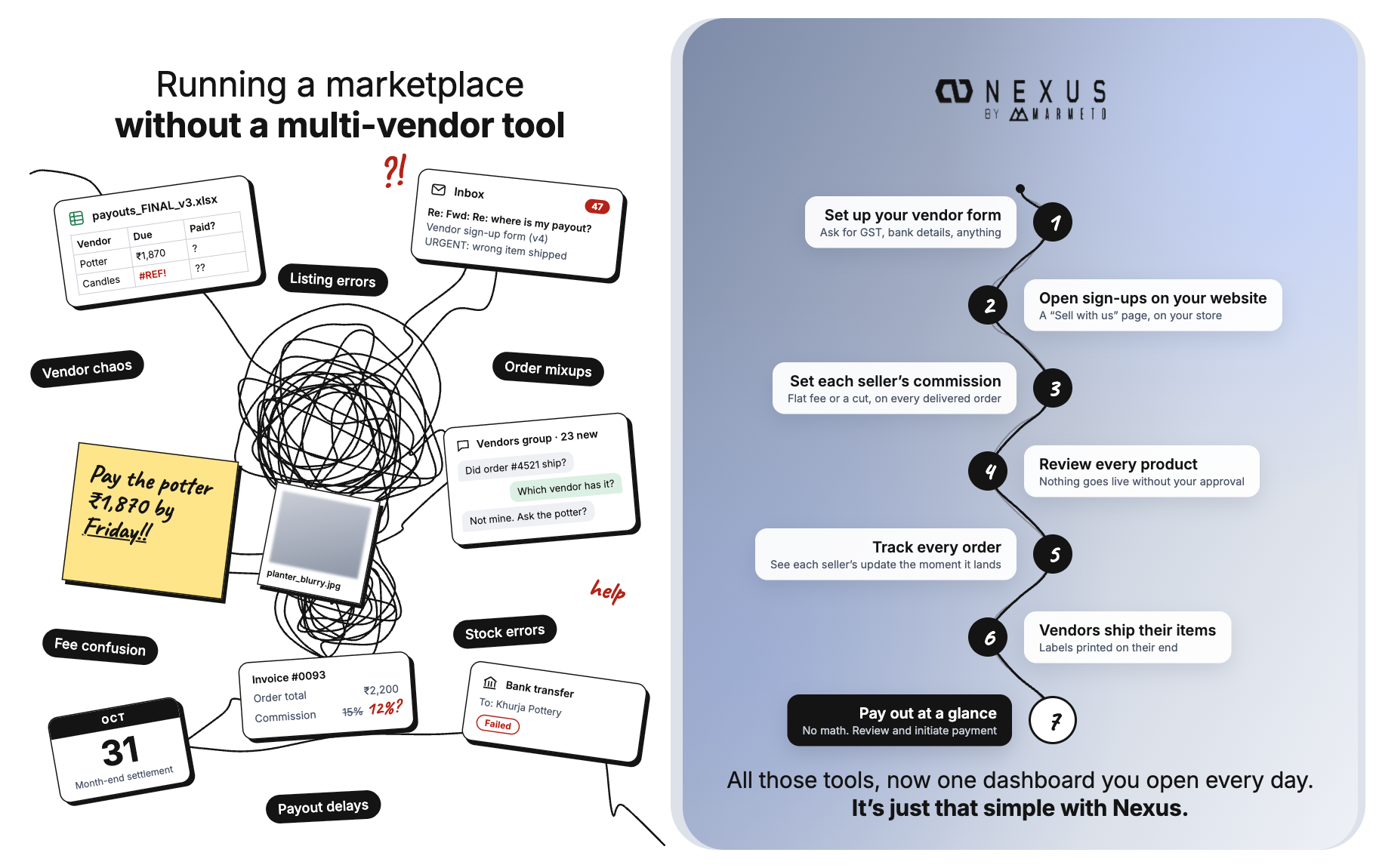
But then what is a check list you need before onboarding your first seller?
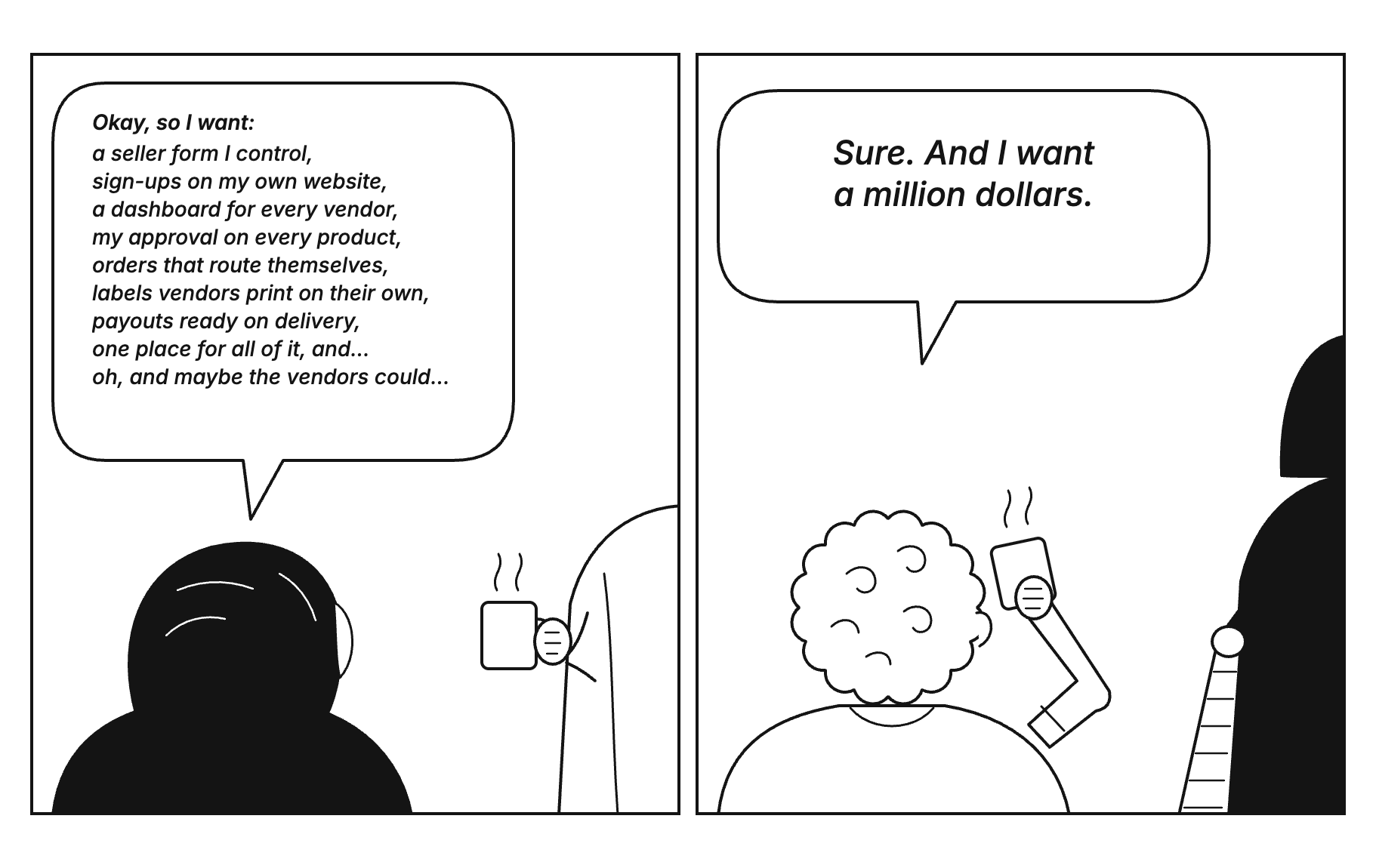
Strip away the spreadsheets and emails, and a marketplace that runs itself needs only these things:
- A seller form you control. You decide what to collect from vendors, from tax details to bank information, and change the fields whenever you need. Meera asks every artisan for their GST number and the craft they practise.
- Registration from your own website. You tell vendors "register on my website", not "here is a link to some other app". Mitti & Co's artisans sign up from a "Sell with us" page on Meera's own website.
- A dashboard for every vendor. Vendors don't belong in your admin. They need their own space, easy to reach, showing only their work. The candle maker in Pune logs in from her phone and sees her 12 candles and her orders, nothing else.
- Your approval on every product. Vendors add and edit their listings, but nothing goes live until you say so. When the Khurja potter uploads a planter with a blurry photo, Meera sends it back before any customer sees it.
- Product fields for SEO. You define the extra fields your store needs; vendors fill in the values. Meera adds material, dimensions and care instructions, so every listing answers what buyers type into Google.
- Orders routed to the right vendor. When an order has items from three vendors, each one sees only their part. Ananya's ₹4,200 order becomes three tasks: one for the block printer, one for the candle maker, one for the potter.
- Shipping labels for vendors. Vendors generate a label and hand the parcel over, without emailing you for one. The potter prints a label, the courier picks up in Khurja, and Meera's team never touches the parcel.
- A payout ready with every delivery. Each delivered order settles itself, so paying vendors is not a month-end project for your team. The day Ananya's planter arrives, the potter's ₹1,870 is ready to pay: ₹2,200 less Meera's 15% commission.
- One place for all of it. Sellers, products, orders and payouts in one place, not five tools you switch between. Today Meera's team juggles Shopify, a Google Sheet, Gmail, WhatsApp and a banking app. That is the five.
It actually is that simple, with Nexus - your Multi vendor marketplace hero
Meera does not need five developers and a year. She needs a multi-vendor marketplace app, and Shopify has several. Shipturtle, Puppet Vendors, Webkul and Garnet all turn a Shopify store into a marketplace, each with its own take on setup and pricing.Nexus is ours. It brings sellers, products, orders and payouts into one dashboard, so Meera's team stops switching between five tools.
Here is what we focused on while building it.
- Built for people, not for software experts
Nexus uses the words you already use: sellers, products, orders and payouts. No course to take before your first sale. - Priced for a store that is just starting
Plans start at $9 a month, and every plan comes with a 14-day free trial. - Real humans, on every plan
Whether you pay $9 or $99, you chat with a real person on our team, any time of day.
At Marmeto, we build for people first. Nexus is no exception. Install Nexus from the Shopify App Store and try it free for 14 days.
FAQ
- If a customer buys from three sellers in one order, who ships what?
Nexus splits the order by seller. Each seller sees and ships only their own items, and earns commission only on what they deliver. - Do I have to approve every product a seller uploads?
Yes, and that’s by design. Every product passes your review before it goes live. Your customer's experience matters here. - Can my sellers’ team member log in too?
Yes. Sellers add their team from Settings > Users in their own dashboard, so no one shares a password. - How is my commission calculated?
On the product’s selling price. Set 10% on a $100 product, and you earn $10 from that sale. - Can my seller sign up from my website instead of a Nexus link?
Yes. You can embed the seller registration form on your own site. Sellers find your store, and register from there.
E-commerce store vs MarketplaceThings require to run a marketplaceRun your marketplace on Nexus